
A Taiwan eSIM is one of the easier travel purchases in Asia. Taiwan’s mobile networks are fast, the big airports have operator counters, and there is no rule we could find that stops a visitor from arriving with a roaming eSIM bought at home. The part that catches people out is inside the plan list rather than at the border. In our catalog, the two largest Taiwan plans are also the two cheapest, and both only start working in Taiwan after you register your passport online.
This guide goes through that trade with the real numbers. It covers what a local Taiwanese SIM asks of a foreign visitor, what all six Taiwan-only plans we list cost, when a regional Asia pack is the better buy, and one side effect of where each plan’s traffic exits to the internet. You can browse the current Taiwan eSIM plans or the full travel eSIM catalog.

Can you use a travel eSIM in Taiwan?
Yes. A travel eSIM connects in Taiwan the same way your home SIM does when it roams: it attaches to a Taiwanese partner network as a visiting subscriber. We found no Taiwanese rule that stops a tourist from doing this.
What Taiwan does have is a strict real-name system for its own mobile numbers, and it has pushed that system outward when roaming SIMs were abused. In November 2023 the Taipei Times reported that Chunghwa Telecom, Taiwan’s largest carrier, had told China Unicom Hong Kong that “only users whose identifications have been verified can access roaming services in Taiwan,” and that it had blocked 25,500 of that operator’s SIM cards from roaming in Taiwan since August that year. The cards had been used in phone scams.
That background explains the one registration step you may meet with a travel eSIM for Taiwan. Most plans we list need nothing: the supplier text says there are “no other activation or registration steps” after scanning the QR code. Two plans, both issued by a Hong Kong operator, are different, and we cover them in detail below.
What a local Taiwan SIM asks of a visitor
If you would rather buy locally, expect to show two identity documents, not one.
Taiwan Mobile’s FAQ lists a passport as the primary document for foreigners and a second document from a list that includes a visa, an entry or exit permit, a residence permit, an international driving permit or a travel document issued by a foreign government. Both originals have to be presented in a store. Chunghwa Telecom’s tourist page says its prepaid cards are sold at service centres in four major airports and around Taiwan, as a physical SIM or an eSIM, with day-pass plans that include unlimited mobile internet and free voice credit. It also says the products “can be only purchased using NTD cash.”
So a local SIM is a good deal if you land during counter hours, have Taiwanese dollars on hand and carry a second ID. It also gives you a Taiwanese phone number, which a travel eSIM does not. A travel eSIM is the simpler route if you want to be online when the plane lands, skip the queue, or arrive late at night.
How much data does a Taiwan trip need?

Size for the days you rely on mobile data, not for the nights you booked.
Taiwan is easy on data in some ways. Public transport is well signed, and the government’s free iTaiwan Wi-Fi runs at public buildings, tourist sites and transport stations. Where data use climbs is on day trips: the train to Jiufen or Hualien, ride-hailing in the evening, translating menus, and maps in night markets.
A rough guide, using the plans below:
- A three or four day Taipei stop, mostly on hotel Wi-Fi: 3 GB.
- A standard week with day trips: 5 to 10 GB.
- Two weeks or more around the island, maps and messaging all day: 15 GB or more.
- Tethering a laptop or uploading a lot of video: 30 GB.
Validity is a ceiling, not a trip length. A 30-day plan does not mean you need 30 days, and on some plans the clock starts earlier than you might expect. Our guide to when travel eSIM validity starts explains the different triggers.
What the six Taiwan plans cost
Our catalog lists 12 Taiwan-only items. Six are plans you buy fresh and six are top-up add-ons for a plan you already hold. Here are the six plans, from two providers.
| Data | Days | Provider | Price | Registration |
|---|---|---|---|---|
| 1 GB | 14 | Sparks | $4.99 | none |
| 3 GB | 30 | Sparks | $9.99 | none |
| 5 GB | 30 | Sparks | $13.99 | none |
| 10 GB | 30 | Sparks | $20.99 | none |
| 15 GB | 30 | 3 (Hong Kong) | $12.99 | passport, online |
| 30 GB | 30 | 3 (Hong Kong) | $15.99 | passport, online |
Read the price column from top to bottom and the ladder breaks at 15 GB. The 30 GB plan costs $5 less than the 10 GB plan and gives three times the data. Per gigabyte, the Sparks plans run from $4.99 down to $2.10, and the two larger plans come in at about $0.87 and $0.53.
You can top up any of these six and share its data as a hotspot. Each is set up for 5G, which you get where the partner network and your phone support it.
Why the biggest Taiwan plans cost the least, and the step they need
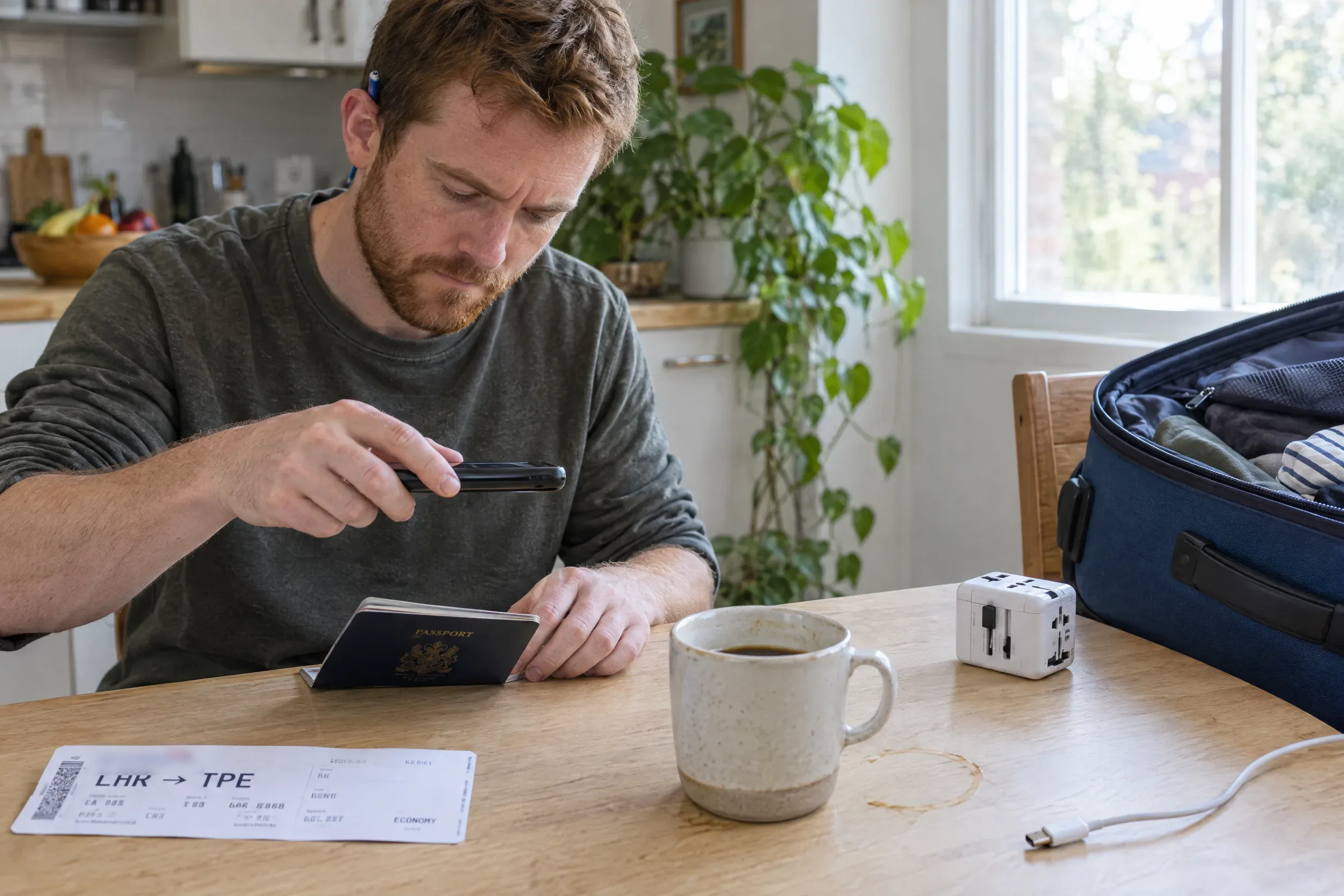
The two cheap plans are issued by 3, the Hong Kong mobile operator, and they come with a condition stated on the product page: “eKYC is mandatory to enable usage in Taiwan. Registration is done online on the official website after downloading the eSIM.”
In practice that means three things.
You scan your passport before the plan works in Taiwan. The supplier’s instructions say to open the operator’s registration link on your phone while connected through the eSIM, scan your passport and leave the auto-filled fields alone. The operator has a separate quick registration page for Taiwan use. Follow those steps and the supplier describes the process as quick auto-registration. Change the auto-filled details, or deviate from the steps, and the supplier says the request goes to manual review, which takes “not less than 24 hours.”
Do it before you fly. If you register on arrival and something sends you to manual review, you could spend your first day in Taiwan without mobile data. Registering at home, while your normal connection is still there as a backup, removes that risk.
Install close to your trip. On these two plans the validity starts when you scan the QR code, not when you first use data in Taiwan. Installing a week early means losing a week of the 30 days. Separately, each plan must be activated within two months of purchase.
The supplier also notes that registration is not required when the eSIM is used outside Hong Kong and Taiwan. That is not much use on a Taiwan-only plan, but it tells you the requirement comes from these two places rather than from the operator in general.
If you would rather avoid a passport scan altogether, the four Sparks plans need no registration and start their clock on first data use. You pay more per gigabyte for that.
When a regional Asia pack is the better buy
For small and medium amounts of data, a multi-country pack is often cheaper than the Taiwan-only plan, even if Taiwan is your only stop.
We list 48 multi-country plans that include Taiwan, not counting add-ons. Two ranges from TSimTech stand out on price:
| Data | Taiwan-only plan | Asia 14 Countries | Greater China and Taiwan |
|---|---|---|---|
| 3 GB | $9.99, 30 days | $6.99, 15 days | $6.99, 7 days |
| 5 GB | $13.99, 30 days | $9.49, 15 days | $9.49, 15 days |
| 10 GB, 30 days | $20.99 | $14.99 | $16.99 |
| 20 GB, 30 days | none | $26.99 | $31.99 |
| 30 GB, 30 days | $15.99 (needs registration) | $39.99 | $30.99 |
The Asia 14 Countries pack covers Taiwan, Japan, South Korea, Hong Kong, Macau, Thailand, Vietnam, the Philippines, Malaysia, Indonesia, Cambodia, Laos, India and Bangladesh. The Greater China pack covers Taiwan, mainland China, Hong Kong and Macau. Neither needs registration.
There are three trade-offs. Both ranges start their clock when the eSIM first connects to a network, which can be the moment your phone attaches after landing. Neither can be topped up, so if you run out, you buy another plan. And from 15 GB up, the two plans from 3 are cheaper than any regional pack we list: at 30 GB the gap is $15.99 against $30.99.
So the decision comes down to size. Up to 10 GB, check the regional packs first, and they are the obvious choice if the trip also takes in Tokyo, Seoul or Hong Kong. Above 10 GB, the Taiwan-only plans from 3 are the cheapest, as long as you are willing to register. We explain the general arithmetic in regional versus single-country eSIM pricing.
Where does your IP address land?
Outside Taiwan, on every plan we list for it. On two of the exit points, that changes which apps work.
A travel eSIM usually sends your traffic out to the internet from the provider’s home country, not the country you are standing in. For the Taiwan plans in our catalog the exits are:
- The four Sparks Taiwan plans: United Kingdom.
- The two Taiwan plans from 3: Hong Kong.
- The Asia 14 Countries pack: Singapore.
- The Greater China and Taiwan pack: Macau.
Most sites will not care. A few services will. We checked the supported-country pages that OpenAI and Anthropic publish for their AI services, and Google’s list of regions for its Gemini API. As of September 2026, all three include Taiwan, the United Kingdom and Singapore, and none of the three includes Hong Kong or Macau. If you rely on an AI assistant for translation or planning, a plan that exits in Hong Kong or Macau may leave those apps refusing to work even though you are standing in Taipei, where they are available.
Streaming apps, banking apps and some Taiwanese websites can also react to an exit country that does not match your location. The mechanism is explained in our guide to travel eSIM IP addresses and country egress.
Does a Taiwan eSIM give you a Taiwanese phone number?
No. All 12 Taiwan-only items we list are data only, with no calls and no SMS, and the same is true of the 48 regional packs that include Taiwan.
For most visitors that is fine, since messaging apps work over data. It matters if a local service wants to text a code to a Taiwanese number. A data-only eSIM cannot receive it, and neither can your home SIM, because the code is sent to a Taiwanese number you do not have. Keep your home SIM active in the second slot for your own bank and email codes. We cover the options in data-only eSIMs versus calls and SMS.
How fast are Taiwan’s mobile networks?
Fast enough that the network is rarely the bottleneck.
Speedtest’s Global Index, in its August 2026 edition, which uses a rolling three-month window, puts Taiwan’s median mobile download speed at 110.74 Mbps with a median latency of 17 milliseconds. That ranks Taiwan 44th in the world and puts it slightly above the global median of 109.05 Mbps. Your own speed on a travel eSIM also depends on the partner network, the plan and your phone, and traffic that exits in another country adds some distance to every request.
When you are indoors with poor signal, iTaiwan Wi-Fi is a reasonable backup. The official site says it has more than 5,000 hotspots in government offices, tourist attractions and public transport stations, and that since 1 July 2020 neither residents nor foreign visitors need to register. It also says the service provides 1M of bandwidth per user, which is enough for messages and email but not for video calls. Treat it as a fallback, not as your main connection.
What happens after you pay?
The eSIM arrives by email as a QR code. We measure the time from payment to the delivery email being accepted by the recipient’s mail server: across the 7 orders where we hold delivery records, the median is 11 seconds and the slowest was 13 seconds. From payment to order completion, the median across 14 orders is 7 seconds, and the slowest order we have handled took 14 minutes. These are small samples, so treat them as a description of what has happened so far, not a guarantee.
If no QR code arrives within an hour of payment, a refund is started automatically. You do not have to ask for it. Card refunds then take the usual few working days to reach your account.
If you choose one of the two plans from 3, the QR code is only the first step. Leave time to complete the passport registration before you travel.
FAQ
Do I need to register a travel eSIM in Taiwan?
Only on some plans. Four of the six Taiwan-only plans we list, and the regional packs that include Taiwan, need no registration beyond scanning the QR code. The two plans issued by the Hong Kong operator 3 require an online passport scan before they work in Taiwan.
What do I need to buy a local SIM in Taiwan as a tourist?
Two identity documents. Taiwan Mobile, for example, asks foreigners for a passport plus a second document such as a visa, an entry permit or an international driving permit, presented as originals in store. Chunghwa Telecom’s tourist SIMs and eSIMs are sold for Taiwanese dollars in cash.
Which Taiwan eSIM is cheapest?
It depends on size. In our catalog the 30 GB plan from 3 costs $15.99 and the 15 GB plan costs $12.99, both cheaper than the 10 GB Taiwan-only plan at $20.99, but both need passport registration. Up to 10 GB, TSimTech’s Asia 14 Countries pack is cheaper than the Taiwan-only plan at the same size.
Will ChatGPT work on a Taiwan eSIM?
It depends on the plan’s exit country. Taiwan, the United Kingdom and Singapore appear on OpenAI’s supported-country list, but Hong Kong and Macau do not. On the two Taiwan plans that exit in Hong Kong, or on a pack that exits in Macau, AI apps may refuse to connect.
Can I use a Taiwan eSIM as a hotspot?
Yes. All six Taiwan-only plans we list allow hotspot use, and so do all 48 regional packs that include Taiwan. Tethering a laptop uses data quickly, which is where the larger plans pay off.
Conclusion: pick by size, then by the passport step
For up to 10 GB, compare the Taiwan-only plans with the Asia 14 and Greater China packs, and take the regional pack if it is cheaper and you do not need to top up. For 15 GB or more, the plans from 3 are the cheapest we list, provided you register your passport before you fly and install the eSIM close to departure. If you would rather have no registration and a clock that starts on first use, the Sparks plans cost more but ask nothing of you after the QR code.
Before you buy, confirm
- Your phone is eSIM-capable and not carrier-locked.
- You bought and installed before you fly, so you land connected.
- The plan’s validity covers your whole trip, counted from when it starts rather than from your arrival.
- If you chose a plan from 3, you finished the passport registration before departure.
- You checked the plan’s exit country if you depend on AI apps, banking or streaming.
Soft next step
Affordable travel eSIM, refund if no code in 1 hour. Compare the current Taiwan eSIM plans side by side, or see every plan that covers Taiwan, regional packs included, in the catalog at 10 GB for 30 days. Plan details change, so treat the live listing on each product page as the source of truth before you buy.