
Short answer: A Sri Lanka-only eSIM starts at $4.49 for 1 GB, and all 8 plans we list allow hotspot and top-ups. They are tagged 4G/LTE, not 5G. The 10 GB, 30-day plan costs $14.99, only $2 more than 5 GB. For a typical week or ten days, buy the 10 GB plan at $14.99.
| Trip length | Typical use (moderate) | Cheapest Sri Lanka plan that covers it |
|---|---|---|
| 3 days | 2–4 GB | 5 GB for 30 days, $12.99 |
| 7 days | 4–7 GB | 10 GB for 30 days, $14.99 |
| 10 days | 6–10 GB | 10 GB for 30 days, $14.99 |
| 14 days | 8–14 GB | 20 GB for 30 days, $41.99 |
| 30 days | 15–25 GB | 50 GB for 30 days, $49.99 |
Prices checked on 7 October 2026. Usage ranges come from our trip data calculator, which also gives light and heavy ranges. The 14-day row has two cheaper routes, covered below.
This guide covers what all 8 Sri Lanka plans cost, why the 10 GB plan is priced so far below the ones around it, when a 16-country Asia pack beats the Sri Lanka plan, what to do if the trip continues to India or the Maldives, what a tourist SIM costs at Colombo airport, how much of the island each operator covers, and what we could and could not confirm about signal in the hill country and the national parks. You can compare the current Sri Lanka eSIM plans or browse the full travel eSIM catalog. Plan details change, so treat the live listing on each product page as the source of truth before you buy.

What do the 8 Sri Lanka plans cost?
Our catalog lists 16 Sri Lanka-only items. Eight are top-up add-ons for a plan you already hold. The other 8 are plans you buy fresh, from two providers: five from Sparks and three from Ubigi.
| Plan | Validity | Provider | Price |
|---|---|---|---|
| 1 GB | 14 days | Sparks | $4.49 |
| 3 GB | 15 days | Ubigi | $7.99 |
| 3 GB | 30 days | Sparks | $8.49 |
| 5 GB | 30 days | Sparks | $12.99 |
| 10 GB | 30 days | Ubigi | $14.99 |
| 10 GB | 30 days | Sparks | $23.99 |
| 20 GB | 30 days | Sparks | $41.99 |
| 50 GB | 30 days | Ubigi | $49.99 |
Prices checked on 7 October 2026. Per gigabyte, the price runs from $4.49 on the 1 GB plan down to $1.50 on the Ubigi 10 GB plan and $1.00 on the 50 GB plan.
What all 8 plans share:
- Hotspot is allowed on every one, so a laptop or a travel companion’s phone can share the connection.
- Top-ups work on every one. If you run out in Ella, you add data to the same eSIM.
- Data only. None includes a Sri Lankan phone number, calls or SMS.
- The clock starts on first data use. All 8 are listed as activating when they first connect to data, not when you install them. You can install at home and switch the line on when you land in Colombo.
- Tagged 4G/LTE. None is tagged for 5G. More on that below.
There is no unlimited Sri Lanka plan in our catalog. The largest is 50 GB.
Why is the 10 GB plan the one to buy?
Because the prices do not rise evenly with size. Two providers price the same country differently, and the gaps are large.
- 5 GB to 10 GB costs $2. The 5 GB plan is $12.99 and the Ubigi 10 GB plan is $14.99. Unless you are sure 5 GB is enough, the extra $2 buys twice the data.
- The same 10 GB costs $14.99 or $23.99. Both run for 30 days, both allow hotspot and top-ups. The $9 difference is the provider.
- 20 GB costs almost as much as 50 GB. The 20 GB plan is $41.99 and the 50 GB plan is $49.99.
That last gap matters for a two-week trip. The moderate range for 14 days is 8–14 GB, and no single-country plan sits between 10 GB and 20 GB. The Sri Lanka-only 20 GB plan costs $41.99. There are two cheaper ways to get there:
- Buy the 10 GB plan and top up if you need to. We list a 10 GB top-up for the Ubigi plan at $14.99. If you use the first 10 GB, the second brings the total to $29.98 for 20 GB. If you never need it, you paid $14.99.
- Buy the 16-country Asialink pack with 20 GB for $25.99. It covers Sri Lanka and is cheaper than the Sri Lanka 20 GB plan. The next section explains what it is.
For a month of moderate use, 15–25 GB, the 50 GB plan at $49.99 is the only Sri Lanka plan large enough. The 10 GB plan with one or two top-ups costs less than that and may be all you use.
One note on validity. Six of the eight plans run for 30 days. The 1 GB plan lasts 14 days and the Ubigi 3 GB plan lasts 15. Validity is a ceiling: a plan stops when its days run out, even with data left. For a stay of three weeks, skip those two. Our guide to when travel eSIM validity starts explains how the days are counted.
Is a regional pack cheaper than a Sri Lanka plan?
At one size, yes. At most sizes, no.
We list 41 multi-country plans that include Sri Lanka. Fourteen of them cover between 11 and 30 countries and 27 cover more than 50. The cheapest at most sizes is Asialink, a 16-country pack that covers Sri Lanka along with Thailand, Vietnam, Singapore, Malaysia, Indonesia, Japan, South Korea and others.
| Data | Sri Lanka only | Cheapest pack that includes Sri Lanka |
|---|---|---|
| 1 GB | 14 days, $4.49 | 14 days, $6.49 (79 countries) |
| 3 GB | 30 days, $8.49 | 30 days, $9.99 (16 countries) |
| 5 GB | 30 days, $12.99 | 30 days, $12.99 (16 countries) |
| 10 GB | 30 days, $14.99 | 30 days, $18.99 (16 countries) |
| 20 GB | 30 days, $41.99 | 30 days, $25.99 (16 countries) |
Prices checked on 7 October 2026.
So at 5 GB the two cost the same, and at 20 GB the 16-country pack is $16 cheaper. If you want 20 GB in a single purchase, buy the pack even if you never leave Sri Lanka. At 10 GB the Sri Lanka plan is $4 cheaper, and that is the size most trips need.
All 41 packs allow hotspot and all 41 can be topped up. None is tagged for 5G. One thing to check before you buy a pack: 6 of the 41 are listed as activating when the eSIM is installed, not on first data use. With those, installing a week early uses up a week of validity. The Asialink packs in the table activate on first data use.
What if the trip continues to India or the Maldives?
Sri Lanka is often paired with one of its neighbours, and the answer is different for each.
India. 31 of the 41 packs that include Sri Lanka also cover India. The 16-country Asialink pack is not one of them. The packs that cover both are the larger and dearer ones, so two single-country eSIMs usually cost less: a Sri Lanka plan, and an India plan, which we list from $4.99 for 1 GB. A phone can hold both, and you switch the data line in settings when you land. Our India eSIM guide covers the India side, including the registration rules for local SIMs there.
Maldives. None of the 41 packs covers the Maldives. We list three Maldives-only plans, and they cost more per gigabyte than anything in Sri Lanka: 1 GB for 7 days at $12.99, 2 GB for 15 days at $21.99 and 3 GB for 30 days at $30.99. Most resorts include Wi-Fi, so a small plan for the transfer days is usually enough. You can see them on the Maldives eSIM plans page.
A Sri Lanka-only eSIM stops working when you leave the country.
Do Sri Lanka eSIM plans include 5G?
Not in our catalog. All 8 Sri Lanka plans, and every pack that includes Sri Lanka, are tagged 4G/LTE.
5G itself is new in Sri Lanka. Dialog, the largest operator, announced the commercial launch of its 5G network on 18 December 2025, with more than 220 live sites, after the regulator’s first 5G spectrum auction. SLT-Mobitel’s tourist plan page, as it read on 7 October 2026, describes “4G & 5G services (in selective areas)”. So 5G exists, mainly where the towers have been upgraded, and the plans we sell are not listed for it.
For a visitor this matters less than it sounds. Maps, messaging, ride-hailing apps, video calls and photo uploads all work on 4G. If 5G speed is the reason you are buying, a local operator’s SIM is the way to get it. Our guide to which travel eSIMs give you 5G explains how to read the tag.
Our listings do not name the local operator a plan connects to, so we do not state one here.
One background fact for anyone carrying an old handset. Dialog said in December 2022 that it would shut down its 3G network in 2023 and keep its 2G network for voice alongside 4G. Any phone that supports eSIM also supports 4G, so this does not affect a travel eSIM.
How good is coverage outside Colombo?

It depends on the operator more than in most countries. Sri Lanka has three mobile operators, Dialog, SLT-Mobitel and Hutch, since Dialog completed its purchase of Airtel Lanka in June 2024. The regulator, TRCSL, published these figures in a market review dated June 2026:
| Operator | Population covered by 4G or better | Land area covered by 4G or better |
|---|---|---|
| Dialog | 99% | 91% |
| SLT-Mobitel | 97.8% | 79.2% |
| Hutch | 94% | 67.1% |
Where people live, all three are close. By land area they are far apart, and the land without coverage is the land travellers go to see: mountains, forest reserves and empty coast. Our listings do not say which of the three a plan connects to, so we cannot tell you which row applies to your eSIM. Treat the table as the range.
Will you have signal on the Kandy to Ella train and on safari?
We looked for a source that measures mobile signal along the hill country railway and inside the national parks, and did not find one.
What can be said with confidence is how mobile networks are built: towers go where people live. The railway from Kandy to Ella passes towns such as Hatton, Nanu Oya and Haputale, and between them it runs through tunnels, cuttings and steep valleys. Expect the connection to come and go on that ride, whichever eSIM or SIM you carry. A travel eSIM uses the same towers as a local SIM, so it cannot find signal where there is none.
The national parks are thinly populated by definition. Yala also has a history with phones. In July 2015 the telecom regulator asked the mobile operators to suspend service inside Yala National Park during the morning and afternoon safari hours on trial dates, after complaints that leopard sightings shared by phone were drawing crowds of jeeps to one spot. That was a trial more than a decade ago and we found no official statement on whether any restriction applies today. Plan your safari as if you will be offline for it.
What this means in practice:
- Download offline maps for the hill country and the south coast before you leave Colombo or Kandy. Navigation apps keep showing your position by GPS without a data connection if the map is saved on the phone.
- Save train tickets, hotel bookings and your driver’s number as screenshots. Do not count on loading an email at a small station.
- Do uploads and video calls in town. Kandy, Nuwara Eliya, Ella, Galle and the beach towns are where the towers are.
- Days on the train and on safari use less data than days in Colombo, because the phone is offline for part of them.
eSIM or a tourist SIM at Colombo airport?
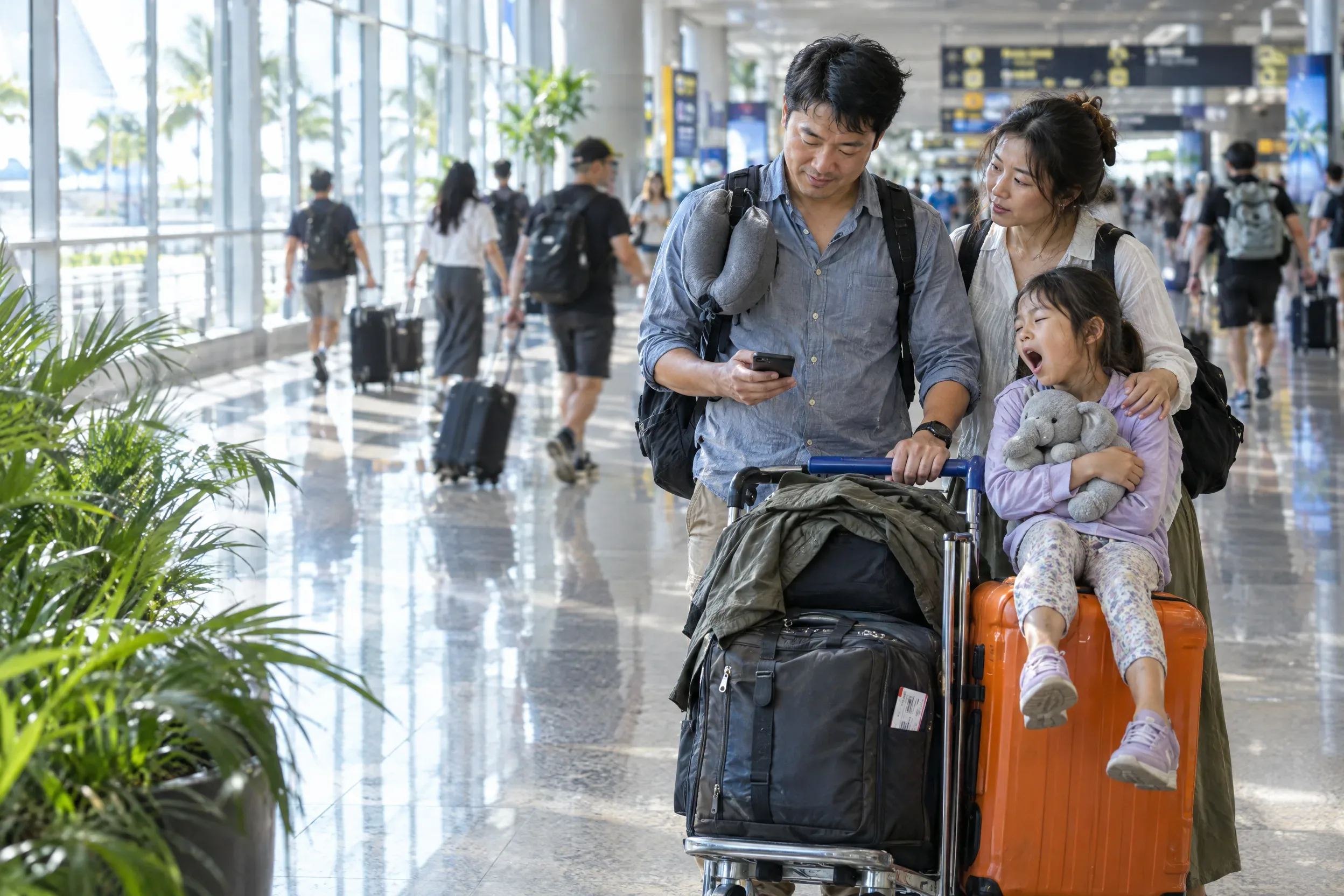
A local tourist SIM is the other option, and in Sri Lanka it is cheap.
SLT-Mobitel’s tourist plan page listed these on 7 October 2026:
- SLT-Mobitel Tourist Plan 01: Rs. 821 from the operator, with 15 GB of local data, unlimited local calls and 1,000 SMS, valid 7 days.
- SLT-Mobitel Tourist Plan 02: Rs. 1,540 from the operator, with 30 GB of local data, unlimited local calls and 1,000 SMS, valid 30 days.
- SLT-Mobitel Tourist Plan 03: Rs. 5,131 from the operator, with non-stop data under a fair-use policy, unlimited local calls and 1,000 SMS, valid 30 days.
These are the operator’s own SIMs, bought from the operator. We do not sell them.
The same page says the SIM is sold at a counter in the arrival lobby of Bandaranaike International Airport, at Mattala and Jaffna airports and at any SLT-Mobitel outlet, that it is available as an eSIM, and that “you only need your foreign passport”.
Dialog, the other operator with airport stores, listed three tourist SIMs of its own on the same date. Dialog’s own tourist SIMs were priced at Rs. 1,399, Rs. 1,799 and Rs. 2,450 on its page, and Dialog includes 20 GB, 30 GB and 50 GB with them in that order, plus a small amount of call credit. Dialog says it has two stores right after the customs desk in the arrival lobby, and that you present your passport there for verification.
On price per gigabyte the local SIM wins clearly. Dialog’s own page puts its Rs. 2,450 plan at about 7 US dollars for 50 GB, against the $14.99 we charge for 10 GB, and a local SIM comes with a Sri Lankan number. If the lowest cost is what matters and you do not mind a stop at the counter after a long flight, buy local.
What the travel eSIM gives you is a connection that is already installed when the plane lands: no queue, no passport handed over, and a working phone for the ride-hailing app or the message to your driver while you wait for bags. That convenience is what the price difference pays for.
Sri Lanka also has a device registration rule that travellers sometimes read about. Since late January 2025 the regulator, TRCSL, requires phones and other SIM devices to be registered before they work on local networks. Speaking about the rule to the Daily Mirror in January 2025, TRCSL’s Director General said that “foreigners arriving in Sri Lanka will not be affected by the new system concerning the electronic devices they bring with them”. TRCSL’s own page on device approval does not spell out a visitor exemption in writing, so that statement is what we have to go on. Both operators’ tourist pages ask for a passport and nothing else.
If you are coming from the United States, the third option is a carrier day pass. Verizon’s TravelPass country list included Sri Lanka at $12 per day in October 2026. Seven days on the pass come to $84, against $14.99 for our 10 GB Sri Lanka plan for the whole stay. A day pass keeps your own number working for calls and texts, which a data-only eSIM does not.
Which country will websites think you are in?
Probably not Sri Lanka. The five Sparks plans list their internet exit point as the United Kingdom, so websites may see a British address. The three Ubigi plans, including the $14.99 10 GB plan, do not list an exit point.
This can affect banking and streaming apps and anything else that decides what to show you by IP address, and search results may default to another country until you set your location. Distance also adds delay, because traffic that leaves Sri Lanka for Europe and returns travels a long way. Video calls may feel slower than a speed test suggests. The mechanism is explained in our guide to travel eSIM IP addresses and country egress.
What happens after you pay?
The eSIM arrives by email as a QR code. We measure the time from payment to the delivery email being accepted by the recipient’s mail server: across the 9 orders where we hold delivery records, the median is 11 seconds and the slowest was 13 seconds. From payment to order completion, the median across 16 orders is 7 seconds, and the slowest order we have handled took 14 minutes. These are small samples, so treat them as a record of what has happened so far, not a guarantee.
If no QR code arrives within an hour of payment, a refund is started automatically. You do not have to ask for it. Card refunds then take the usual few working days to reach your account.
None of the Sri Lanka plans comes with a phone number, so keep your home SIM active in the second slot for bank and email codes, with its data roaming switched off. Our guide to data-only eSIMs and one-time passcodes covers that setup.
FAQ
What is the cheapest eSIM for Sri Lanka?
The 1 GB, 14-day plan at $4.49 is the cheapest Sri Lanka plan we list. For a week or ten days of normal use, the 10 GB, 30-day plan costs $14.99, which is only $2 more than the 5 GB plan.
Do Sri Lanka eSIMs support 5G?
Not the ones we list. All 8 Sri Lanka plans are tagged 4G/LTE. Dialog launched commercial 5G in December 2025, and a local operator’s SIM is the way to use it.
Can I use a Sri Lanka eSIM as a hotspot?
Yes. All 8 Sri Lanka plans allow hotspot use, and so do all 41 multi-country plans that include Sri Lanka. Sharing with a laptop uses data quickly, so choose a larger plan.
Does a Sri Lanka eSIM work in India or the Maldives?
No. A Sri Lanka-only plan stops at the border. 31 of the 41 packs that include Sri Lanka also cover India. None covers the Maldives, where we list separate plans from $12.99.
Do I need to register my phone to use it in Sri Lanka?
According to the regulator, no. Sri Lanka has required device registration since late January 2025, and the regulator’s Director General said that month that foreigners arriving in the country are not affected for the devices they bring with them.
Conclusion: 10 GB for $14.99, and top up if you need more
For a trip that stays in Sri Lanka, buy the 10 GB plan at $14.99 for anything up to about ten days, and add a 10 GB top-up if a longer trip uses it up. If you want 20 GB in one purchase, the 16-country Asialink pack at $25.99 is cheaper than the Sri Lanka 20 GB plan. For India, add a second eSIM. Then save your maps and tickets offline before the train into the hills.
Before you buy, confirm
- Your phone is eSIM-capable and not carrier-locked.
- You installed the eSIM before you fly, so you land connected.
- The plan’s validity covers your whole stay, counted from first data use.
- If you chose a multi-country pack, its listing says it activates on first data use, not on installation.
- You downloaded offline maps and saved your train tickets for the hill country.
Soft next step
Affordable travel eSIM, refund if no code in 1 hour. Compare the current Sri Lanka eSIM plans side by side, or see every plan that covers Sri Lanka, packs included, in the catalog at 10 GB for 30 days. Plan details change, so treat the live listing on each product page as the source of truth before you buy.