
Short answer: A South Africa-only eSIM starts at $4.49 for 1 GB, and all 8 plans we list are tagged for 5G, allow hotspot and can be topped up. Coverage follows towns and main roads, so plan to be offline on game drives. For a typical week, buy the 10 GB, 30-day plan at $26.99.
| Trip length | Typical use (moderate) | Cheapest South Africa plan that covers it |
|---|---|---|
| 3 days | 2–4 GB | 5 GB for 21 days, $15.99 |
| 7 days | 4–7 GB | 10 GB for 30 days, $26.99 |
| 10 days | 6–10 GB | 10 GB for 30 days, $26.99 |
| 14 days | 8–14 GB | 20 GB for 30 days, $47.99 |
| 30 days | 15–25 GB | 25 GB for 30 days, $58.99 |
Prices checked on 5 October 2026. Usage ranges come from our trip data calculator, which also gives light and heavy ranges.
This guide covers what all 8 South Africa plans cost, why a regional or global pack is the wrong buy for a trip that stays in the country, what happens when a self-drive crosses into Eswatini, Lesotho or Botswana, where Kruger National Park has signal according to the park’s own pages, and what a local SIM costs. You can compare the current South Africa eSIM plans or browse the full travel eSIM catalog. Plan details change, so treat the live listing on each product page as the source of truth before you buy.

What do the 8 South Africa plans cost?
Our catalog lists 16 South Africa-only items. Eight are top-up add-ons for a plan you already hold. The other 8 are plans you buy fresh, from two providers: five from NextLink and three from Ubigi.
| Plan | Validity | Provider | Price |
|---|---|---|---|
| 1 GB | 7 days | NextLink | $4.49 |
| 3 GB | 15 days | NextLink | $10.99 |
| 3 GB | 15 days | Ubigi | $13.99 |
| 5 GB | 21 days | NextLink | $15.99 |
| 10 GB | 30 days | NextLink | $26.99 |
| 10 GB | 30 days | Ubigi | $28.99 |
| 20 GB | 30 days | NextLink | $47.99 |
| 25 GB | 30 days | Ubigi | $58.99 |
Prices checked on 5 October 2026. Per gigabyte, the price falls from $4.49 on the smallest plan to $2.36 on the largest.
What all 8 plans share:
- Listed for 5G. Every one is tagged 5G/4G/LTE. More on what that means below.
- Hotspot is allowed on every one, so a second phone or a laptop in the car can share the connection.
- Top-ups work on every one. If you run out halfway through the Garden Route, you add data to the same eSIM.
- Data only. None includes a South African phone number, calls or SMS.
- The clock starts on first data use. All 8 are listed as activating when they first connect to data, not when you install them. You can install at home and switch the line on when you land in Johannesburg or Cape Town.
Where they differ is small. At 3 GB and 10 GB the two providers sell the same size and validity, and NextLink is $3 and $2 cheaper. Ubigi is the only one with a 25 GB plan. There is no unlimited South Africa plan in our catalog, so a heavy user buys 20 GB or 25 GB and tops up.
Why does validity matter more than usual here?
Three of the eight plans expire quickly: 1 GB lasts 7 days, 3 GB lasts 15 days and 5 GB lasts 21 days. Validity is a ceiling. A plan stops working when its days run out, even if most of the data is unused.
That changes the choice for long, slow trips. Someone spending three and a half weeks between Cape Town, the Winelands and the Garden Route may only need 5 GB, but the 5 GB plan ends on day 21. The cheapest plan that lasts the whole stay is 10 GB for 30 days at $26.99. For any stay longer than 21 days, the 30-day plans are the only ones that fit, and for a stay longer than 30 days you will need a second plan. Our guide to when travel eSIM validity starts explains how the days are counted.
Is a regional or global pack cheaper than a South Africa plan?
No. In South Africa the single-country plan wins at every size where both exist, and the gap is wide.
We list 28 multi-country plans that include South Africa. Twenty of them cover more than 50 countries, three cover between 11 and 30, and five are a 10-country Africa pack. Here is how the cheapest of them compares with the cheapest South Africa plan of the same size.
| Data | South Africa only | Cheapest pack that includes South Africa |
|---|---|---|
| 1 GB | 7 days, $4.49 | 7 days, $8.99 (126 countries) |
| 3 GB | 15 days, $10.99 | 30 days, $18.99 (154 countries) |
| 5 GB | 21 days, $15.99 | 30 days, $27.99 (154 countries) |
| 10 GB | 30 days, $26.99 | 30 days, $44.99 (154 countries) |
The Africa-branded packs are dearer still. The 23-country Africa pack costs $66.99 for 10 GB over 30 days, and the 10-country Africa pack costs $114.99 for the same size.
Two things the packs do give you. The 3 GB and 5 GB packs run for 30 days, against 15 and 21 days for the South Africa plans of those sizes. And they keep working when you cross a border, which the next section covers. All 28 allow hotspot and all 28 can be topped up. None of them is tagged for 5G in our listings.
So the rule is simple: if the whole trip is inside South Africa, buy the South Africa plan.
What if the road trip crosses a border?

Many self-drive routes leave South Africa for a day or two. The drive from Kruger to the KwaZulu-Natal coast often cuts through Eswatini, the Drakensberg sits against Lesotho, and plenty of itineraries add Botswana or Mozambique. A South Africa-only eSIM stops working at the border.
We checked which neighbours our catalog covers on 5 October 2026.
| Neighbour | Plans that also cover South Africa | Cheapest pack covering both |
|---|---|---|
| Botswana | 15 | 1 GB for 7 days, $9.49 (154-country pack) |
| Eswatini | 10 | 1 GB for 30 days, $10.99 (23-country pack) |
| Mozambique | 8 | 1 GB for 7 days, $9.49 (154-country pack) |
| Zambia | 6 | 1 GB for 7 days, $8.99 (126-country pack) |
| Lesotho | 3 | 1 GB for 30 days, $16.99 (179-country pack) |
| Namibia | none | We list no plan that covers Namibia |
| Zimbabwe | none | We list no plan that covers Zimbabwe |
None of these neighbours has a single-country plan in our catalog. The cover comes from the multi-country packs.
The cheapest way to handle a short crossing is usually two eSIMs: the South Africa plan for the bulk of the trip, and a small pack for the days across the border. A phone can hold both and you switch the data line in settings. For a transit of a few hours through Eswatini, offline maps may be all you need. If your route includes Namibia or the Zimbabwe side of Victoria Falls, we cannot help with data there today, and it is better to know that before you leave.
Where is there signal in Kruger National Park?
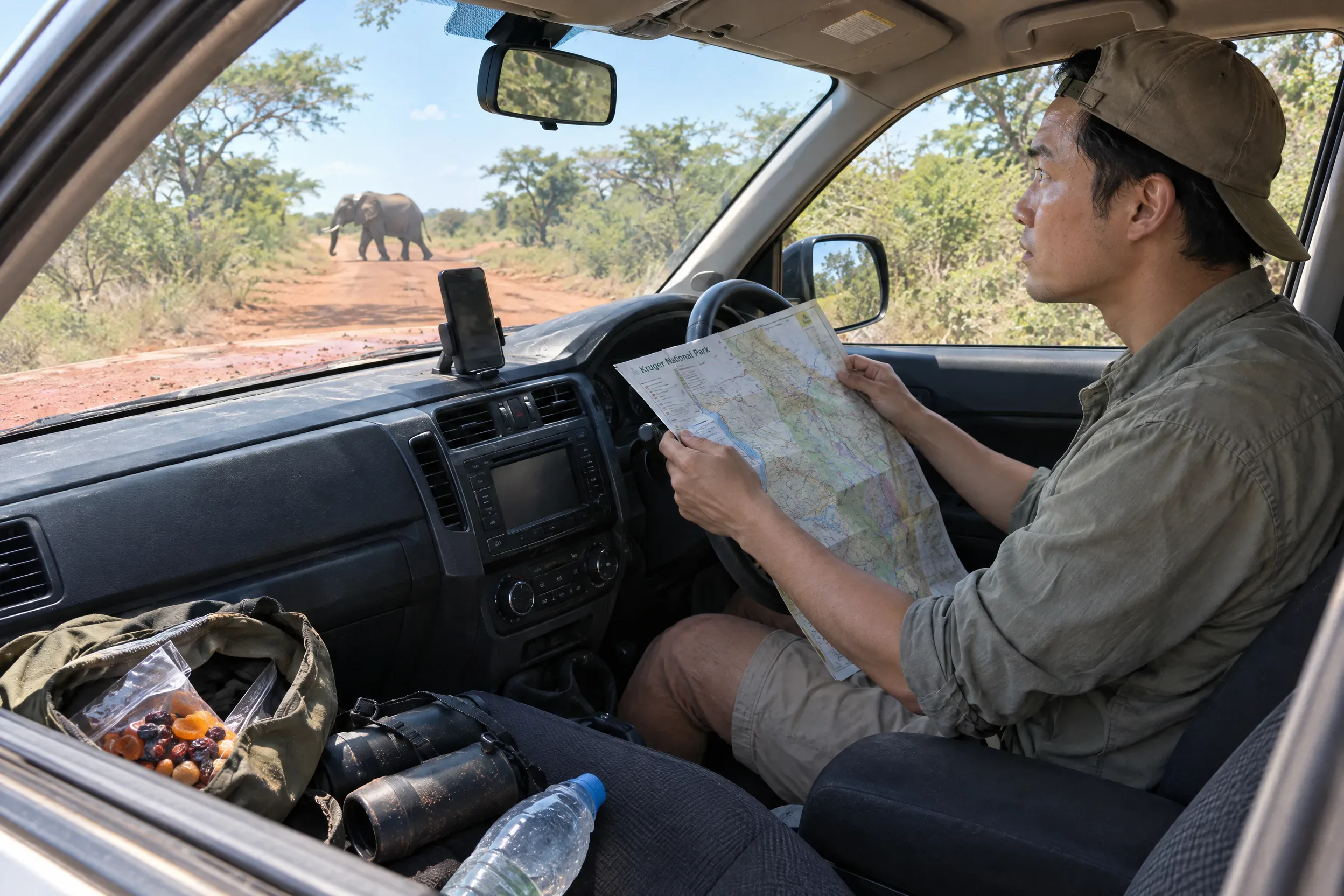
At the main rest camps, according to the park. On the roads between them, plan to be offline.
South African National Parks (SANParks) lists facilities for each Kruger camp. As its pages read on 5 October 2026, “Cellphone reception” appears in the facilities list of all 12 main rest camps: Berg-en-Dal, Crocodile Bridge, Letaba, Lower Sabie, Mopani, Olifants, Orpen, Pretoriuskop, Punda Maria, Satara, Shingwedzi and Skukuza. Punda Maria, in the far north, is also listed with “No Wi-Fi”. The pages do not say which operator the reception comes from or how strong it is.
The smaller camps are different. The page for Sirheni Bushveld Camp says “No cellphone reception”, and the page for Roodewal Bush Lodge says no cellphone reception is available and that the nearest camps are Satara, 44 km away, and Olifants, 28 km away. If you book a bushveld camp or bush lodge, read its page before you count on an evening connection.
SANParks also sets a rule that matters more than the coverage map. Its visitor rules for Kruger say that the use of cell phones is permitted only in camps, at gates and in cases of emergency. A game drive is meant to be quiet, and the park does not promise signal on it.
We could not find an official source that maps signal on Kruger’s roads, so we are not going to guess. Visitor reports describe coverage as patchy between camps, and that fits how mobile networks are built: towers go where people stay. What this means in practice:
- Download the park map and your route before you enter the gate. Navigation apps will keep showing your position by GPS without a data connection, as long as the map is saved on the phone.
- Do your uploads and calls at camp. Photos, messages and the next day’s bookings can wait for the evening.
- Tell someone your route if you are driving the quieter northern roads. A travel eSIM uses the same towers as a local SIM, so it will not find signal where there is none.
- Private lodges in the reserves beside Kruger set their own rules on phones and connectivity. Ask the lodge before you book if being reachable matters.
One consequence for plan size: days inside the park use less data than days in Cape Town, because the phone is offline for most of the daylight hours. If most of a week is spent in Kruger, the light range in our calculator, 2–3 GB for 7 days, is realistic, and the 3 GB, 15-day plan at $10.99 covers it. If the week is split between the bush and a city, stay with 10 GB.
How good is coverage on the rest of a self-drive route?
South Africa’s regulator, ICASA, publishes coverage figures each year from operator reports. Its State of the ICT Sector report dated March 2026 gives these national numbers for 2025:
| Network | Share of population covered |
|---|---|
| 3G | 99.85% |
| 4G/LTE | 99.5% |
| 5G | 58.0% |
Those are shares of people, not of land. The same report puts geographical broadband coverage at 82.1%, which leaves close to a fifth of the country’s area without it. South Africa is large and much of it is thinly populated: the Karoo on the N1, the Wild Coast, the mountain passes of the Drakensberg and the Cederberg. The report does not map where the uncovered area is. On a self-drive, assume it is on those long empty stretches, and save your maps before you set off.
In rural areas, the report says every province had more than 89% of its rural population covered by 4G/LTE in 2025. Rural 5G is a different story:
| Province | Rural population with 5G |
|---|---|
| Gauteng | 74% |
| Mpumalanga | 63% |
| Western Cape | 34% |
| Limpopo | 29% |
| Free State | 25% |
| North West | 16% |
| KwaZulu-Natal | 15% |
| Northern Cape | 13% |
| Eastern Cape | 7% |
Kruger lies in Mpumalanga and Limpopo. The Garden Route runs through the Western Cape into the Eastern Cape. So on a road trip, expect 4G for most of the drive and 5G mainly in and around cities.
Do South Africa eSIM plans include 5G, and does the 3G switch-off matter?
All 8 South Africa plans are tagged 5G/4G/LTE. The tag means the plan is allowed onto 5G where the partner network has it and your phone supports it. It is not a promise of 5G at any particular place, and with 58% of the population covered, you will often be on 4G. For maps, messaging and video calls, 4G is enough. Our guide to which travel eSIMs give you 5G explains how to read the tag.
Our listings do not name the local operator a plan connects to, so we do not state one here.
South Africa is also retiring its older networks. The government’s spectrum policy, published in the Government Gazette on 28 May 2024, sets the start of the 2G and 3G shutdown at 1 June 2025 and the total shutdown at 31 December 2027. The same policy says the minister will review and republish that timeline, so the end date can move. For a visitor the effect is small. A travel eSIM is data only, and any phone that supports eSIM also supports 4G. The people affected are those still carrying a 3G-only handset.
One more thing travellers ask about. If you have read that rolling power cuts, known locally as load shedding, are part of daily life in South Africa, that picture is out of date for now. In a statement published by the government news agency on 4 October 2026, Eskom said the country had recorded 504 consecutive days without load shedding.
That can change, and it says nothing about local faults. A power bank in the car is still sensible on a long drive, for the simple reason that navigation drains a phone battery.
eSIM or a local SIM at the airport?
A local prepaid SIM is the other option. It takes more effort on arrival.
South African law (RICA) requires every SIM to be registered to an identified person before it works. Vodacom’s help page, as it read in October 2026, says a foreign national needs a valid passport, that proof of address may be required depending on the registration type, and that the rule applies to prepaid, contract, physical SIMs and eSIMs. So bring your passport and your accommodation booking to the operator’s shop.
On price, the local SIM wins. Vodacom’s own prepaid page listed these monthly once-off bundles on 5 October 2026: R99 for 5 GB plus 5 GB of night-time data, R149 for 10 GB plus 10 GB of night-time data, and R229 for 20 GB plus 20 GB of night-time data. At any recent exchange rate, R149 is well under the $26.99 we charge for 10 GB. If the lowest cost per gigabyte is what matters and you do not mind the registration step, buy local.
What the local SIM gives you that a travel eSIM does not is a South African number for local calls. What the eSIM gives you is a working connection as the plane door opens, with nothing to register and no shop to find after a long flight. That convenience is what the price difference pays for.
If you are coming from the United States, the third option is a carrier day pass. Verizon’s TravelPass page listed South Africa at $12 per day in October 2026, charged on the days you use the phone abroad. Seven days on the Verizon pass come to $84, against $26.99 for our 10 GB South Africa plan for the whole stay. A day pass keeps your own number working for calls and texts, which a data-only eSIM does not.
Which country will websites think you are in?
Not always South Africa. The five NextLink plans list their internet exit point as Western Europe, so websites may see a European address. The three Ubigi plans do not list an exit point.
This can affect South African banking and streaming apps and anything else that decides what to show you by IP address, and search results may default to another country until you set your location. Distance also adds delay, because traffic that leaves South Africa for Europe and returns travels a long way. Video calls may feel slower than a speed test suggests. The mechanism is explained in our guide to travel eSIM IP addresses and country egress.
What happens after you pay?
The eSIM arrives by email as a QR code. We measure the time from payment to the delivery email being accepted by the recipient’s mail server: across the 9 orders where we hold delivery records, the median is 11 seconds and the slowest was 13 seconds. From payment to order completion, the median across 16 orders is 7 seconds, and the slowest order we have handled took 14 minutes. These are small samples, so treat them as a record of what has happened so far, not a guarantee.
If no QR code arrives within an hour of payment, a refund is started automatically. You do not have to ask for it. Card refunds then take the usual few working days to reach your account.
None of the South Africa plans comes with a phone number, so keep your home SIM active in the second slot for bank and email codes, with its data roaming switched off. Our guide to data-only eSIMs and one-time passcodes covers that setup.
FAQ
What is the cheapest eSIM for South Africa?
The 1 GB, 7-day plan at $4.49 is the cheapest South Africa plan we list. For a week of normal use, the 10 GB, 30-day plan costs $26.99. Multi-country packs that include South Africa cost more at every matching size.
Will an eSIM work in Kruger National Park?
At the main rest camps, yes. SANParks lists cellphone reception at all 12 main rest camps, and says there is none at Sirheni Bushveld Camp or Roodewal Bush Lodge. Between camps, plan to be offline, and note that park rules allow phone use only in camps, at gates and in emergencies.
Can I use a South Africa eSIM as a hotspot?
Yes. All 8 South Africa plans allow hotspot use, and so do all 28 multi-country plans that include South Africa. Sharing with a laptop uses data quickly, so choose a larger plan.
Does a South Africa eSIM work in Eswatini, Lesotho or Namibia?
No. A South Africa-only plan stops at the border. We list multi-country packs that cover Eswatini and Lesotho together with South Africa. We list no plan that covers Namibia or Zimbabwe.
Can I top up a South Africa eSIM?
Yes. All 8 South Africa plans can be topped up, so you can add data to the same eSIM if you run out before the trip ends.
Conclusion: 10 GB for a week, and download the map before the gate
For a trip that stays in South Africa, buy 5 GB at $15.99 for a long weekend, 10 GB at $26.99 for a week to ten days, 20 GB at $47.99 for two weeks and 25 GB at $58.99 for a month. Skip the regional and global packs unless the route crosses a border, and for a short crossing add a small pack instead of replacing the main plan. Then save your maps offline, because the eSIM cannot help on the stretches of road where no network reaches.
Before you buy, confirm
- Your phone is eSIM-capable and not carrier-locked.
- You installed the eSIM before you fly, so you land connected.
- The plan’s validity covers your whole stay, counted from first data use.
- Your route stays inside South Africa, or you have a second plan for the days across the border.
- You downloaded offline maps for Kruger and for every long stretch between towns.
Soft next step
Affordable travel eSIM, refund if no code in 1 hour. Compare the current South Africa eSIM plans side by side, or see every plan that covers South Africa, packs included, in the catalog at 10 GB for 30 days. Plan details change, so treat the live listing on each product page as the source of truth before you buy.