
Most Philippines trips are really several trips stapled together. You land in Manila or Cebu, take a domestic flight to Palawan or Siargao, then spend a few days on boats where the nearest tower is a long way off. Two questions follow you the whole way: whether you are allowed to buy a local SIM at all as a visitor, and how much data to carry when your route keeps leaving the grid.
This guide answers both. It covers what the SIM Registration Act actually says about tourists, why a local tourist SIM expires in a way a travel eSIM does not, what all 16 Philippines-only plans in our catalog cost size by size, and the one tradeoff that makes the cheapest plan the wrong plan for some travellers. Plan details change, so treat the live listing on each product page as the source of truth before you buy. You can browse the current Philippines eSIM plans or the full travel eSIM catalog.

Do tourists have to register a travel eSIM in the Philippines?
The registration duty in the law is written around SIMs sold by Philippine operators, and a travel eSIM is not one of those.
Republic Act No. 11934, the SIM Registration Act, says in Section 4 that “all end-users shall be required to register their SIMs with PTEs as a pre-requisite to the activation thereof”. PTE means a public telecommunications entity, and the Act defines an end-user as someone “which purchases a SIM from the public telecommunications entities (PTEs), its agents, resellers or any entity”. The implementing rules go further and name the technology directly: Section 4(a) says that all covered SIMs, “including embedded SIMs (eSIMs)”, which are “provisioned by any PTE”, are subject to registration.
That phrase is the whole answer. The duty attaches to a SIM that a Philippine operator provisions. An international travel eSIM is provisioned by a provider outside the Philippines and reaches you as a roaming subscriber on a partner network. Neither the Act nor its implementing rules contains a single provision about roaming or about SIMs issued by foreign operators.
One caution about how to read that. The law does not say travel eSIMs are exempt. It says nothing about them at all, which is a different thing. What you can rely on is the scope of the text: the obligation as written covers SIMs you buy from a Philippine operator or its resellers, and it is the operator that has to collect your details before activating you.
What a local tourist SIM costs you that a travel eSIM does not
If you do buy a Philippine SIM at the airport, the law sets out what you hand over and how long it lasts. Section 5(e)(1) requires a passport, proof of address in the Philippines, and a return ticket. The implementing rules spell out what counts as proof of address, which is the part travellers worry about needlessly: a booking at a hotel or other accommodation, or failing that a letter from the owner of the place you are staying. Registration itself is free, and the rules say so in as many words, so any fee asked for it is not authorised.
The rules also add the part most visitors miss: a SIM registered for a foreign national visiting as a tourist “shall only be valid temporarily for thirty (30) days, and shall automatically be deactivated upon expiration”.
Smart’s own guidance to customers says the same, and adds that keeping the line past 30 days means presenting an approved visa extension.
So a local tourist SIM has a hard 30-day ceiling attached to your immigration status, plus a counter queue and three documents. A travel eSIM has none of that, and its validity is whatever you bought. For a two-week trip the practical difference is mostly the queue. For a five-week trip it is the difference between one purchase and a renewal errand.
How much data does a Philippines trip actually need?
Size for the days you are on mobile data, not the days you are in the country.
Resorts and cafes in Manila, Cebu, Boracay and El Nido generally have Wi-Fi, so a lot of a Philippines trip runs on someone else’s connection. What burns mobile data here is the in-between: airport transfers, Grab rides, ferry terminals, maps while island hopping, and uploading photos when you finally get signal again.
A useful way to size it, using the price ladder below:
- A weekend city stop, mostly on Wi-Fi: 1 to 2 GB.
- A standard 7 to 10 day trip with one island leg: 3 to 5 GB.
- Two weeks across several islands, maps and messaging all day: 5 to 10 GB.
- Working remotely, tethering a laptop, or uploading video: 10 to 20 GB.
Validity is a ceiling, not a trip length. A 30-day plan does not mean a 30-day trip, and it is worth knowing exactly when that ceiling starts counting, which is covered in our guide to when travel eSIM validity starts.
What 16 Philippines plans cost, size by size
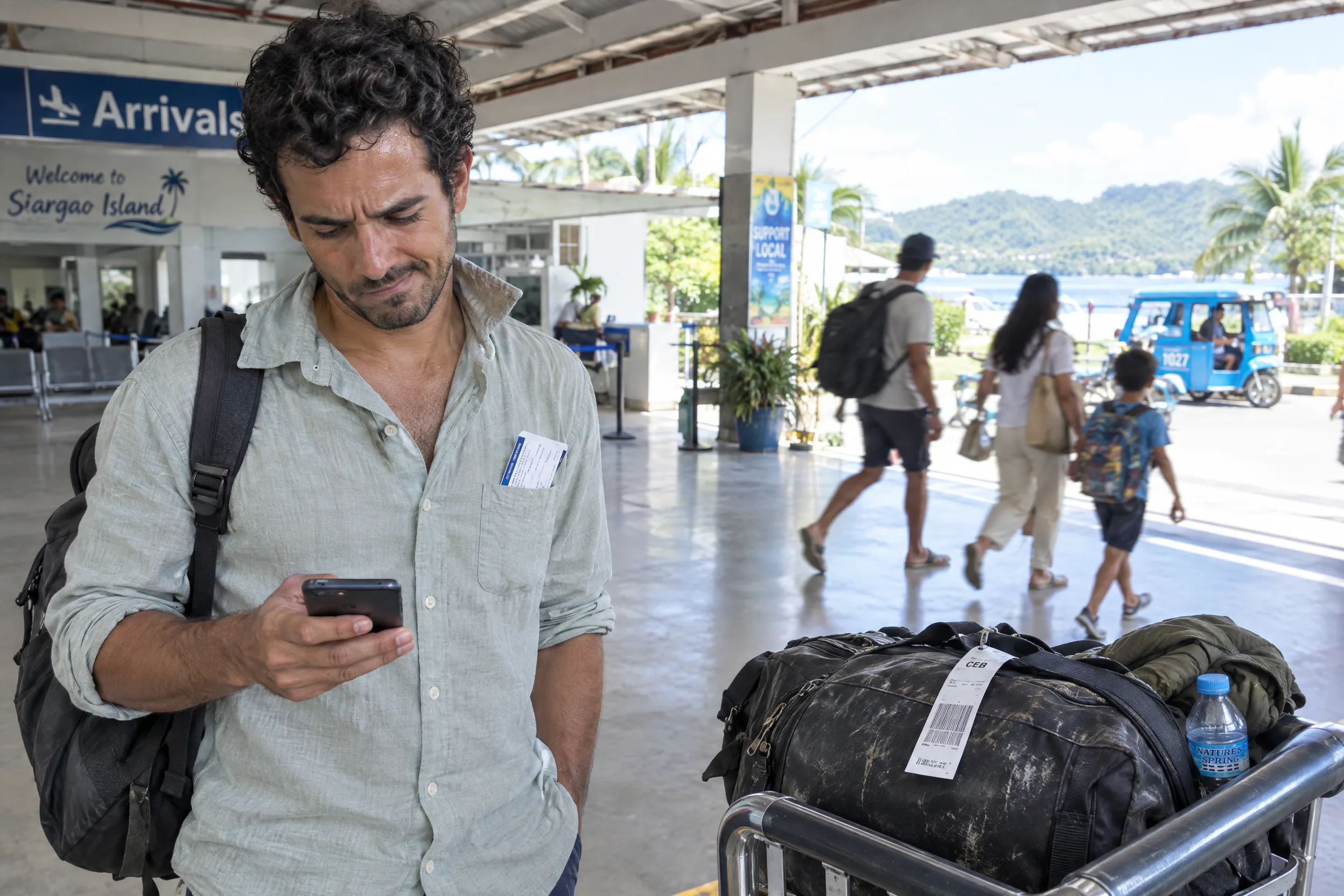
Our catalog currently lists 28 Philippines-only items. Sixteen are plans you buy fresh and twelve are top-up add-ons for a plan you already hold. Here are the sixteen, from three providers, with the per-gigabyte cost worked out.
| Data | Days | Provider | Price | Per GB |
|---|---|---|---|---|
| 1 GB | 7 | Sparks | $4.49 | $4.49 |
| 2 GB | 15 | Airalo | $5.99 | $3.00 |
| 2 GB | 15 | Sparks | $6.99 | $3.50 |
| 3 GB | 5 | TSimTech | $5.49 | $1.83 |
| 3 GB | 30 | Sparks | $8.99 | $3.00 |
| 3 GB | 30 | Airalo | $9.49 | $3.16 |
| 5 GB | 15 | TSimTech | $8.49 | $1.70 |
| 5 GB | 30 | Airalo | $11.99 | $2.40 |
| 5 GB | 30 | Sparks | $12.99 | $2.60 |
| 10 GB | 30 | TSimTech | $12.99 | $1.30 |
| 10 GB | 30 | Airalo | $16.99 | $1.70 |
| 10 GB | 30 | Sparks | $19.99 | $2.00 |
| 20 GB | 30 | TSimTech | $21.99 | $1.10 |
| 20 GB | 30 | Airalo | $25.99 | $1.30 |
| 20 GB | 30 | Sparks | $32.99 | $1.65 |
| 30 GB | 30 | TSimTech | $27.99 | $0.93 |
Two things fall out of that table. The per-gigabyte cost runs from $4.49 at the smallest size down to $0.93 at the largest, a spread of about 4.8 times, so buying too small is expensive per unit and buying far too large wastes the rest. And at 10 GB for 30 days you can pay $12.99 or $19.99 for the same headline product, a difference of 54 percent. At 20 GB the gap is 50 percent.
The inversion is worth seeing plainly: $12.99 buys either 5 GB or 10 GB depending on which provider you pick, and $27.99 buys 30 GB from one provider while $32.99 buys 20 GB from another. Same destination, same 30 days.
Why the cheapest Philippines plan is the one you cannot top up
The provider that wins on price at every shared size is the same provider whose plans behave differently in two ways that matter.
All five TSimTech plans in the table have no top-up path. If you run out on day nine of a twelve-day trip, you buy a whole new plan. The eleven Sparks and Airalo plans can all be topped up, which is usually cheaper than starting again. Our guide to topping up by destination covers how that works.
The same five also start their clock differently. Eleven of the sixteen activate on first data usage. The five TSimTech plans activate on connecting to the network, which in practice can mean the moment your phone attaches at the airport, before you have opened anything. On a 5-day plan that difference is a real fraction of what you paid for.
None of this makes the cheap plans a bad buy. It makes them a good buy for a traveller who has sized generously and is landing to start the trip, and a worse buy for someone on a tight 5-day plan with a long layover, or anyone who expects to extend.
Does a Philippines eSIM give you a local number?
No. Every one of the 28 Philippines items we list is data only, with no voice and no SMS.
That matters more in the Philippines than in many destinations, because Grab, delivery apps and some hotel bookings like to send a code. The workarounds are the usual ones: keep your home number reachable on your other SIM slot for those messages, or use apps that verify by email. We covered the whole decision in data-only eSIMs versus calls and SMS.
Two other catalog facts are worth knowing before you land. All sixteen plans are provisioned for 5G as well as 4G and LTE, although what you actually get depends on the local network and your phone. And all sixteen allow hotspot, which is what you want if you are tethering a laptop from a resort with weak Wi-Fi. Hotspot use drains data fast, so size up if that is the plan.
Where your IP address lands, and why your bank may care

Six of the sixteen plans route your traffic out through the United Kingdom, and one through Singapore.
That is a normal consequence of how roaming eSIMs are built, and most of the time you will never notice. You notice when a banking app decides a login from the wrong country needs another check, or when a streaming service shows you the wrong catalog while you are sitting in Cebu. For the remaining nine plans the field is not populated, so the honest answer is that we do not publish an egress country for them. The mechanism, and what to do about it, is in our guide to travel eSIM IP addresses and country egress.
What happens to coverage in typhoon season?
Networks go down with the power, and they come back in days rather than weeks.
The most recent well-documented case is Super Typhoon Uwan, known internationally as Fung-wong. On the morning of 10 November 2025, the Philippine News Agency reported the Department of Information and Communications Technology’s status figures: Smart at 74 percent of its network online, DITO at 71 percent, Converge at 64 percent and Globe at 54 percent, with Northern Luzon and the Bicol Region hardest hit and Metro Manila fully operational. The department said it expected service restored across the country within 24 to 48 hours.
Two things follow for a traveller. Outages cluster in the storm’s path rather than nationwide, so a trip to Palawan or Siargao is not usually affected by a typhoon hitting Luzon. And because a travel eSIM roams onto whichever partner network is up, it is no more and no less exposed than a local SIM on that same network. The practical defence is the same one that helps on any island leg, which is to have your maps, tickets and accommodation details downloaded before you need them.
Single country or an Asia regional pack?
Forty-one regional and global plans in our catalog also cover the Philippines, on top of thirty top-up add-ons for them. The cheapest is $6.49 for 1 GB over 14 days across 79 countries, and the cheapest at a size worth comparing is $6.99 for 3 GB over 15 days across 14 Asian countries.
If the Philippines is your only stop, the single-country plans above are almost always cheaper per gigabyte. If you are pairing it with Vietnam, Thailand or Singapore on the same trip, the arithmetic changes, and it changes at a point you can calculate rather than guess. We worked through where that break-even sits in regional versus single-country eSIM pricing. If the Philippines is one stop on a longer route, the price map is the faster way to see what each country costs.
FAQ
Do I need to register my travel eSIM with the Philippine government?
The registration duty in RA 11934 applies to SIMs provisioned by a Philippine telecommunications entity, and an international travel eSIM is not provisioned by one. The law and its implementing rules do not address roaming or foreign-issued SIMs at all. If you buy a local SIM at the airport instead, you will need a passport, a Philippine address and a return ticket.
How long does a tourist SIM last in the Philippines?
Thirty days. The implementing rules state that a SIM registered for a foreign national visiting as a tourist is valid temporarily for thirty days and is automatically deactivated on expiry. Keeping it longer means presenting an approved visa extension.
Will my eSIM work in El Nido, Siargao and on the boats?
Expect coverage in the towns and gaps between them. No Philippine operator publishes a coverage guarantee for open-water ferry legs, and the island-level detail that does exist is regional rather than per-beach, so plan for dead zones between towns rather than hoping against them. Download your maps and booking confirmations before you leave the resort. This is one of the destinations where offline maps earn their keep.
Can I use my Philippines eSIM as a hotspot?
Yes, on all sixteen Philippines-only plans we currently list. Tethering is fully allowed, and it is the practical fix for a hotel Wi-Fi that cannot carry a video call. Hotspot use burns data several times faster than phone browsing, so size up if you plan to rely on it.
What if I run out of data halfway through?
It depends which plan you bought. Eleven of the sixteen can be topped up, which is usually cheaper than buying again. The five TSimTech plans cannot, so running out means a fresh purchase. If you think you might extend, that is a reason to pay a little more up front.
Conclusion: pick for your route, not for the headline price
The Philippines is straightforward to stay connected in and slightly awkward to plan for. The legal question that worries most visitors turns out not to apply to travel eSIMs, because the registration duty is written around SIMs that Philippine operators provision. The real decisions are the mundane ones: size for the days you are actually on mobile data, know that the same 10 GB is sold at a 54 percent spread, and check whether the cheapest option is one you can top up before you commit to it on a long trip.
Before you buy, confirm
- Your phone is eSIM-capable and not carrier-locked.
- You bought and installed before you fly, so you land connected.
- The plan’s validity covers your whole trip, counted from when it starts rather than from your arrival.
- You checked whether the plan can be topped up, if there is any chance you will need more.
- You sized for hotspot use if you are tethering a laptop.
Soft next step
Compare the current Philippines eSIM plans side by side, or start from the full travel eSIM catalog if the Philippines is one stop on a longer trip. Plan details change, so treat the live listing on each product page as the source of truth before you buy.